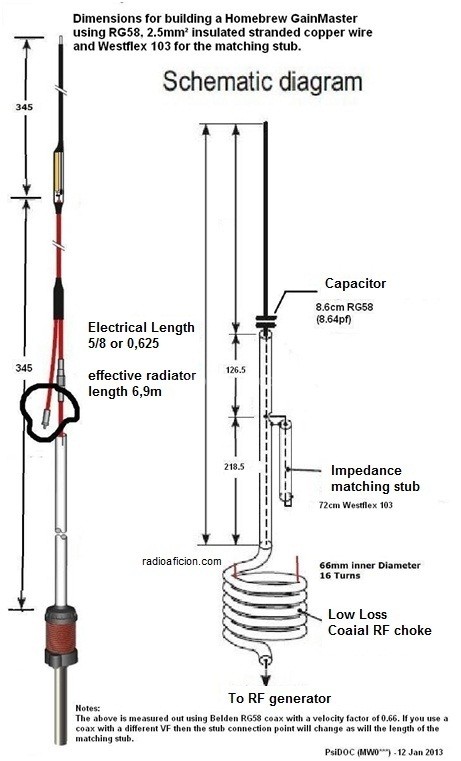
- Top half is wire extending beyond capacitor, bottom half is the outside of the coax shield down to the choke.
- Capacitor in series with the center conductor tunes out the inductive reactance leaving 180 ohms resistive.
- 50 ohm point is found where the stub attaches, the coax from this point running down to the choke is matched to 50 ohms.
- The length of coax between the end of the stub (hanging off the side) and the capacitor forms the total stub length.
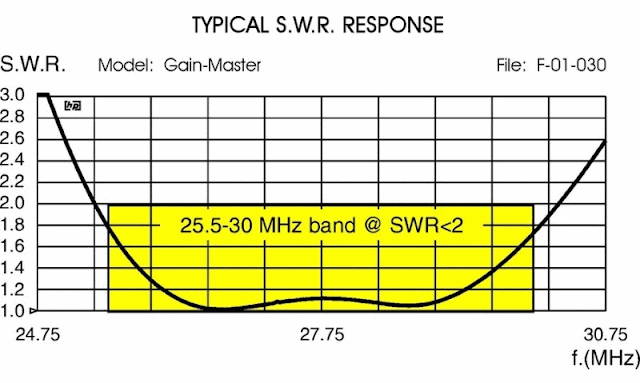
- Assuming I got my math right: The length of the stub is a 1/4 wavelength at 25 MHz when the VF of 0.66 is taken into account! Why this length I'm not sure, we can shorten the stub to be a 1/4 wave at 27.2 MHz and with some trial and error find the 50 ohm point and a cap value that gives a 50 ohm match.
Monday, January 24, 2022
Gain Master Antenna Model
Sunday, January 16, 2022
10m Surprise
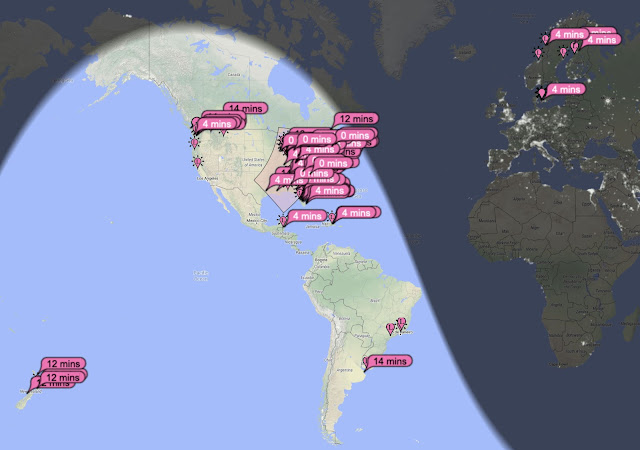
Two days ago a CME occurred, I happened to be on 10m FT8 as prior to this the MUF map suggested the band might open.
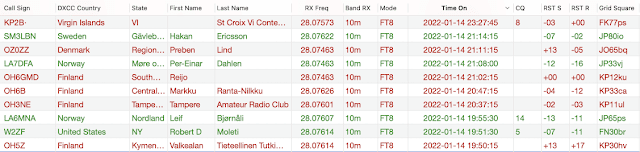
Ten minutes before mid-day my eyes just about fell out of my head when I saw northern EU stations calling CQ up-to 17 dB SNR! A quick look at SolarHam confirmed there had been an CME event, and that I had indeed caught the effects of it as it happened.
Over the next couple of hours logged Finland (4 stations), Norway, Denmark and Sweden. Nothing below or beyond that area showed any signals here.
The polar path was having the usual effects on signals, from "fuzzing" them on the waterfall, to one or two decodes and then nothing, quite a number of partially completed contacts in the FT8 sequence. The signals from northern Europe would come in waves, they'd be there for a couple of minutes then gone again, a few minutes later they're back for a few.
ZL even appeared for a little bit, but nothing else across the Pacific.
EU on 10m, that's a first for me.
Yesterday 10m served up another surprise, while I didn't get any openings to new DX, some very short hop propagation appeared, and I logged three WY stations consecutively, and finally got NM on 10m which completed the last two states I needed for WAS on 10m. That makes ID on 15m the last one needed to complete 5-band WAS.
Wednesday, December 1, 2021
FT8 - Now it makes sense!
For a time FT8 seemed pointless to simply log the minimum for a contact in an automated way and move on, the social side and having a chat getting to know someone, and share ideas is removed from the equation.
I always did see FT8's good points and purpose, its a weak signal mode, efficient, and gets the job done neat and tidy.
Ideal for contesting, special events, or working a DX-Pedition for example to get that rare one in the log where all that is happening is exchanging of callsigns and signal reports anyway. FT8 simply took that function, and made it efficient. No problem with that.
But I was being a Curmudgeon, so back in April this year I tried out FT8 to at least figure out how to drive it. With a busy summer out of the way and fall around the corner I decided time to get a little more serious and start using logging software and maybe work towards getting awards, and QSL cards to stick on the wall.
The result was MacLoggerDX, WSJT-X, JS8Call, Fldigi and Flrig Integration. MacLoggerDX does the right things, and once configured makes rig control, and logging contacts with WSJT-X, JS8Call, and Fldigi seamless, couple mouse clicks and its all done. Now there is no excuse, the tools are in-front me to get to work.
Now it makes sense, a lot of sense. Most FT8 ops upload logs to LoTW, which is appreciated if like me you want them to also count towards awards for example. After a few weeks I had logged and confirmed contacts all over the world, and sent and received a number of QSL cards.
This reminded me how much I enjoyed sending and receiving paper QSL cards too. Today when everything is electronic and instant, it's nice to receive a physical object from somewhere that took a journey.
This mode also spurred me to upgrade my antenna systems. The OCFD was replaced with 130 ft doublet fed with 600 ohm line into a remote auto tuner which is interfaced to the rigs ATU port. This makes band changes seamless, and enables me to operate on all bands 160-10m. I finally assembled the 6m 3 element LFA Yagi I had bought, which then blew down in strong winds a few weeks later, and since tediously unbent with a vice, straight edge and a mallet. See Thats the end of Six meters for a while..
Maybe the spark gap ops didn't like the new kids running vacuum tubes at the time either. It's just an evolution of technology that enables us to set the bar higher. DXCC is easier, so we get that then set the next goal and keep going, and/or set goals with friends and compete.
For example, KL2R and I set the goal of a clean sweep, logging and confirming a contact on every band. This turned out to be quite fun.
I've also logged contacts with friends I've since not heard from in a long time, and follow ups via email sometimes result which is a nice surprise.
All the same I enjoy text chats on JS8, PSK31, and talking to people on voice modes just like always. Remember to stop and smell the roses.
I've simply added an additional mode I can use for awards and other goals, and to get some of those nice QSL cards that would otherwise be much harder or if not impossible to get.
100 countries confirmed in LoTW under three months - I started on September 10th, and 100th country was confirmed on December 1 by E75C. Simply from putting in a consistent effort with a modest station - a single wire antenna, 80W, sometimes 350W when needed.
Time for a break from chasing DX, work on some other projects and think about the next goal..
Sunday, November 14, 2021
Doublet Antenna
130 ft Doublet Antenna, covers all nine HF bands 80m - 10m, and optionally 160m with reasonable patterns.
600 ohm feeder > 1:1 ATU balun > switching network > Remote antenna coupler / tuner.
The conundrum I had was how to get all nine HF bands 80m - 10m, and 160m from one antenna, with reasonable patterns, performance, and rated for high power. My limitation is having 1/4 acre where I can fit at most 130 ft of wire in a straight line horizontally.
Decided a doublet fed with 600 ohm open line into a remote ATU was the best option. Also, linking the feeders together and driving it against ground as a T antenna enables use on 160m, and a useful set of alternate patterns on 80 through 40m.
The matching network we bring into the 21st century, high quality remote ATU and high quality 1:1 ATU current balun. Remember, any system is only as strong as the weakest link..
- Balun Designs model 1171 5 kW 1:1 ATU current balun (studs in, studs out).
- Remote ATU Stockcorner JC-4s 1 kW automatic antenna tuner (5 stars on eHam).
- Doublet and feeder from TrueLadderLine. Could built it, cheaper to buy it vs time.
The JC-4s ATU can be interfaced to Kenwood and Icom rigs to operate via the Tuner button, and setup to bypass keying an amplifier during tuning. See JC-4s Automatic ATU and Icom IC-7300 Hints on PA0FRI's site.
Initially tuner was very slow to find matches on the upper HF bands when interfaced to the Icom ATU port, but was very quick using the supplied manual tuner interface and 15W carrier to tune. The TUNE carrier power in my Icom 7300 was under 10W, raised it to around 15W the per the service manual which solved the problem.
T Antenna mode, this turns it into a vertical with top loading by feeding the two legs of the feeder together against ground:
- 160m - 1/8th wave vertical, top loading results in uniform current along the vertical.
- 80m - 1/4 wave vertical, top loading moves current max to top away from ground noise.
- 60 to 40m - not sure how you would describe it.
So, how does it work? I had it up on Oct 21 but connected to my Icom AH-4 tuner which limited me to 100W while I waited for the JC-4s. With the 100 ft feeder strung up to the AH-4 in a temporary location it tuned all bands except 160m.
The first thing I noticed was how much quieter it is on receive compared to my OCFD which had a Balun Designs OCF balun optimized for the job with a good amount of current choking. Now I wonder how much noise is picked up by the coax shield and leaks or couples past the balun to the antenna, then back into the receiver? Noise dropped two to three S units between 80 and 20m.
So far the results on 12, 15, 17, 20, 30m have been good on FT8. SNR each way mostly equal, and looking the TX/RX performance with other stations in my grid on pskreporter things are fairly comparable.
Morning of 22 Oct 21 I worked 8J1RL Antartica on 40m FT8, about 1 hour after sunrise.
Confirmed in LoTW so not making this up :-)
That I managed to get those three rare ones with only 80W TX on my end was a nice surprise.
Weekend Oct 30 was CQ WW SSB contest, we had some good propagation on the upper bands. Saturday I worked a number of stations on 10m SSB with 100W in South America, Caribbean, and Japan late in the evening. KL7RA a well known contest station in Alaska commented I had the biggest signal on 15m they'd seen.. Probably something to do with one of those 9.8 dBi lobes that falls north west :-) also worked them on 20 and 40m. 9/10 times I'd get heard on the first or second call, following morning on 20m got OH8X (super station in Finland), and a couple others.
Also got excellent reports on 75m AM running "bare foot" 25W carrier power.
13 Nov 2021, I now have the JC-4s installed, and feeder length tuned for good matches on all bands, I used my RigExpert to do this so I can be sure that complex impedances the tuner sees are reasonable.
14 Nov 2021, I see Kuwait operating on 20m FT8, watched for a while no decodes. Checked again an hour or so later, decoding up to -6 dB, tried for 10 - 15 minutes with 80W, no luck. Hit it with 400W and completed the contact. I had to pick my self up off the floor when the RR73 appeared. From my location near Seattle, Kuwait is right over the north pole, middle of day here, night there. Unbelievable.
I'm suspiciously optimistic this antenna just seems to work better than all previous wire antennas I have used by a good margin (dipoles, trapped dipoles, OCFD), it keeps surprising me.
Actual readings taken with a RigExpert analyzer connected to the 1:1 ATU balun in doublet mode:
Band | R Ω | X Ω | SWR |
10m | 162.2 | -93.9 | 4.4 |
12m | 136.3 | -114.1 | 4.8 |
15m | 56.7 | -178.6 | 13 |
17m | 35.7 | -163.1 | 17 |
20m | 52.7 | -259.6 | 28 |
30m | 486.0 | 151.9 | 11 |
40m | 102.4 | -442.2 | 41 |
60m | 98.1 | 109.8 | 4.7 |
75m | 137.9 | -445.6 | 32 |
80m | 313.5 | -659.6 | 34 |
160m | 12.0 | -141.9 | 38 |
This is with the antenna at a height of about 55 ft or 17 m, and approx 70 ft or 21 m of 600 ohm open wire line.
This shows me that the ATU has quite reasonable complex impedances to match, or no wild extremes at least.
R is a little low on 160m but at 130 ft or 40 m long the doublet is well too short at 1/4 wave length, but it does work no doubt with reduced efficiency. In T mode on 160m it would work much better as a DX antenna on transmit at least..
This also highlights the trap of assuming a 4:1 balun should be used, in nearly all cases this would lower the impedance too much. See Tuner Balun 4:1 or 1:1 for more about that.
Introducing the "All Band" Doublet - Cebik.
10 Frequency Asked Questions about the All-Band Doublet - Cebik.
Tuner Balun: 4:1 or 1:1? - G3TXQ.
80-Meter Doublet - KV5R.
Wednesday, August 11, 2021
QSL from RNZ Pacific
Once upon a time 30 something years ago when I first discovered shortwave radio the broadcast bands were filled with stations, a lot of them in english from various countries and interesting to listen to. These days it's hard to find any that are a) in english, and b) not religious.
Once in a while I'll tune around the short wave broadcast bands and see what's around. I got a nice surprise when I found Radio New Zealand Pacific on 13840 kHz (schedule here) a few days ago late in the afternoon. By evening it was quite strong at S9 +20dB with some QSB at my location near Seattle Washington all the way from New Zealand. Sure enough every day I checked I'd find it.
The target audience for RNZ Pacific are the Pacific Islands, but shortwave being shortwave it can go much further, especially with a good receiver and antenna, in my case the off center fed dipole at 55 ft.
I sent them an email, I got a reply and a link to request an eQSL card, which I received today.
Screen capture from the Icom IC-7300